

Yes, yes, gather around children, it is time for a story. Tonight I have prepared for you a very special story. A story of whimsy and woe.
Though, I feel I must warn you children this story will at times be frightening, at times be quite sad, and I must admit that in its entirety it will be rather grotesque. But such is life my children, and the sooner one learns that the better. However, life is also surprising, funny, and full of hope, and this story, as every good story should, contains these things as well.
Now, everyone settled? Good, let us begin.
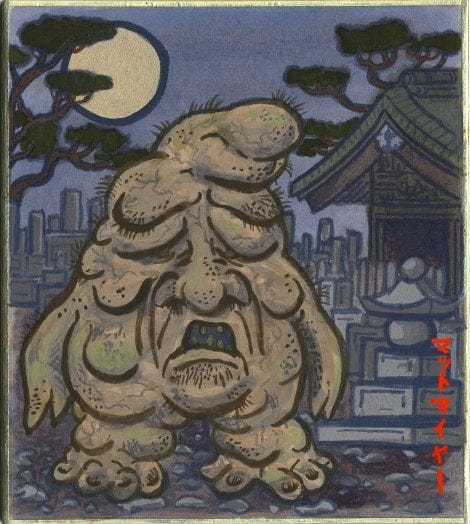
Once upon a time, there was a boy made of meat.
What’s that?
You say all boys are made of meat?
How clever you are, but you are only half right. Let us not forget such sundries as bones, hair, skin, and squishy bits. Far too many squishy bits, if I am being honest.
No, my children, little boys and girls are only half meat at best, but this very special little boy was made entirely and completely of nothing but meat, meat, meat.
But it seems I am getting ahead of myself, for you see, before you can have a boy made of that much meat, you will need just oh so many dead bodies, and wherever you find any such fine collection of carrion you will almost assuredly also find a necromancer.
Settle children, I see a few of you already growing nervous at the mention of necromancers. You, in the back, stop clutching your blanket so. No need to fret! This is not a story of those messy, vulgar necromancers from the borderlands, the ones who stuff their towers with grave-dirt and chicken bones and make a terrible fuss about it. No, no, the necromancer in our tale was a man of distinction and taste, a man whose shoes always matched, whose teeth were never stained, and who could recite four entire volumes of poetry without a single error.
He did, however, have a tower. All the best necromancers do.
But one might ask themselves why be a necromancer? Why build a boy from meat at all, when there are so many perfectly serviceable boys already available, running wild and making a terrible lot of noise in every direction?
Ah, that, children, is the right question. I am glad you asked.
The short answer is, that very few people ever intend to become necromancers, but, of course, every man needs a project. Some sew themselves cloaks from the skin of tigers, some attempt to turn lead into gold (it never works, but the process makes a wonderful mess), and some… well, some seek to create a thing that the world has never seen, a thing that, in its own miserable and improbable way, will outlast them.
Ours was the last kind.
His name was Abe no Seimei, and if you have heard of him already, you know he was the cleverest man in three prefectures and possibly the only one in history to win an argument with an oni without the use of violence or bribery. If you have not heard of him, do not worry. You will know him quite well by the end of this story.
For the moment, imagine a man with a face so sharp you could use it to cut mochi, hair always arranged just so, and a voice so calm and reasonable you would trust him to borrow your best ink brush and actually return it.
Imagine a man so wise and so honorable that even Emperor Ichijo himself came to him for advice. Can you imagine such a man? Do you see him children? Good, then we are ready to truly begin the story.
Now, imagine an immaculate room. Not merely clean, not merely organized, but immaculate. The sort of place where even dust motes paused at the threshold to remove their shoes before entering. The shelves were lined with scrolls in perfect order, each labeled in a hand so precise the letters looked printed rather than brushed. The tatami floor was so pristine it gleamed, and the air itself had the bright, resinous scent of cedar wood and old books, with a faint undercurrent of something metallic and disturbing if you breathed too deeply.
At the center of this temple of tidiness, Abe no Seimei sat behind a lacquered writing desk, absorbed in a document he had already read three times.
He read, and sipped his tea, and read again.
You could be forgiven for thinking Seimei looked quite relaxed, but nothing could be further from the truth. For you see tonight Seimei had a problem. The problem was not the usual kind he faced. The emperor had not been cursed, the imperial court did not need him to remove any stubborn spirits from the walls. No, the problem was rather more serious than that. You see, Seimei’s wife, whom he loved very much, had become suddenly and terribly ill.
I see some of you are shocked that a man like Abe no Seimei had a family, and how foolish of me not to have introduced them properly. Yes, he did have a wife, a son as well, and he loved them quite dearly in his own dry, scholarly way.
Seimei as we now know, was a man of precision. If a chopstick was out of alignment at dinner, if a grain of rice escaped the lacquer bowl and attempted to make a break for the edge of the table, Seimei would correct the situation with a flick of his gaze and the faintest purse of his lips, as if he had not so much noticed the error as simply willed it to cease existing.
Seimei’s wife, as in all the best marriages, was his opposite in every way. She possessed a laugh so bright that it could, and often did, startle birds from the trees in the courtyard. She was fond of bright silks, a good joke, and the way Seimei sneaked looks at her when he thought she was not looking back. A woman who was just as likely to start a food fight as eat her dinner.
Their son, Yoshihira, had inherited none of Seimei’s poise. In fact, if you could imagine a child composed of equal parts curiosity, cleverness, and a sort of blinding enthusiasm you would come very close to imagining Yoshihira. A boy whose preferred method for eating involved using both hands at once, with his mouth open as wide as possible for optimal airflow.
But for all of their differences they loved each other very much, which made what happened next all the harder.
One morning, Seimei’s wife awoke with a fever that had not existed the night before. By afternoon her lips were cracked and her skin sallow, and by evening she could no longer stand. Seimei measured her pulse with two fingers and a frown, consulted three separate diagnostic scrolls, and prescribed a regimen of dried chrysanthemum and ground deer horn that was known to cure most things, if only by boring the disease into submission as much as anything else.
For three days, the household held its breath. Yoshihira, forbidden from the sickroom, watched from the hall, his face pressed to the paper door as Seimei mixed powders and drew careful lines of salt around the futon. But for all his wisdom, and all his learning, Seimei’s wife continued to fade. Her laughter, usually the first sound to greet the morning, became a whisper, and then became nothing at all.
Seimei sat beside her in the pale blue light, his hands folded in his lap, his face so expressionless that for a moment you could mistake him for a statue carved and not a man grieving. It is worth pausing to say that despite his sadness, Seimei did not weep at this time, not once. He had not yet learned how to weep, but I’m sorry to say he would learn, my children, oh he would learn well.
He sat beside his wife for precisely three hours and seven minutes, because as a man of great learning he knew that was the time it took for a soul to leave the body and find its destination. At the end of the seventh minute past the third hour, he reached out and closed her eyes with two fingers, as gently and sadly as one might close the cover at the end of a favorite book.
Yoshihira was allowed to see her before she was taken away, and the boy cried enough for both father and son.
Grief, as anyone who has experienced it might tell you, is a highly personal undertaking, and each person experiences it in their own peculiar way. Yoshihira’s response to grief was to eat little, to play even less, and to sit quietly by the river where no one could hear him cry. Seimei’s response to grief was, predictably, to begin a new project.
A project that in time he, and everyone who knew him, would come very much to regret.
Thanks for reading. This story is a work in progress which I hope to some day publish. As such I welcome all comments and constructive criticism.
If you find you enjoy my work and would like to read more, my first published novel, Grumble and Gasp, is currently available on Kindle and Amazon.
Want to know if I killed off your favorite character? I probably didn’t, but how can you be sure? Stay tuned. New chapters drop every week!
Subscribe to Whimsy and Woe: Side effects may include inappropriate laughter, mild to moderate existential dread, and goose-chase nightmares.
Do not consume Whimsy and Woe if you are allergic to tears, snails, or kumquats.
Ask your doctor if Whimsy and Woe is right for you.
loved every single second of this!!!! i could imagine a grandmother sitting beside a fireplace on a cold winter's night, narrating this story 🥹
🥺 too much woe